Who it is for
For preschool educators and private teachers working with children aged 2–6 (7).
 Sign up for a lesson
A practical Interclass methodology for children aged 2–6 (7): pictograms, themed games, songs and worksheets.
A lesson-building toolkit for preschool educators and private teachers. Choose materials to suit the children's age, the group's level and your kindergarten's requirements.
Discuss the programme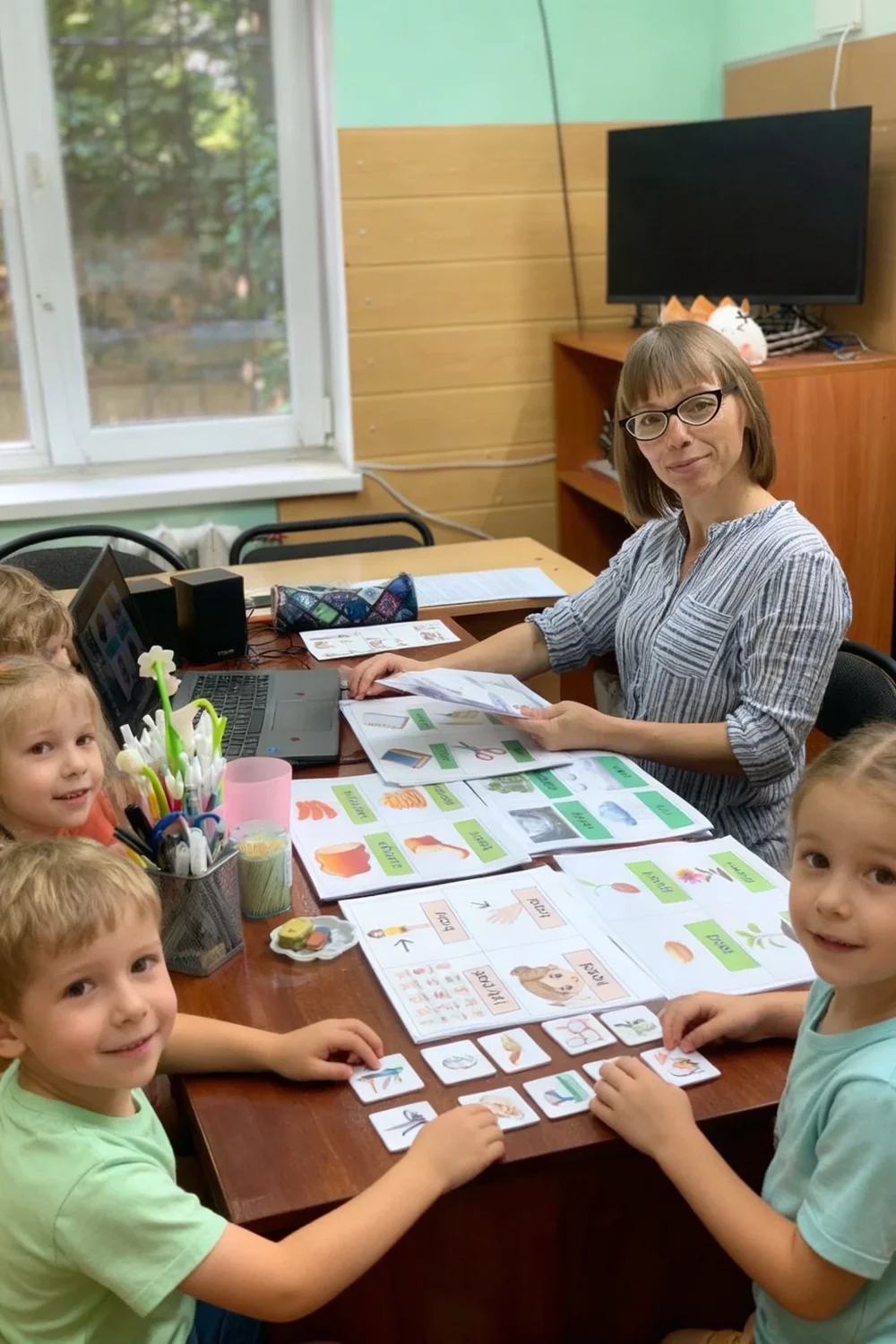
For preschool educators and private teachers working with children aged 2–6 (7).
Support phrase and sentence building with visual models, combining speaking with games and practical activities.
A flexible lesson-building toolkit based on Interclass interactive modelling. The existing description provides for 1 to 5 lessons a week, depending on workload and preschool requirements.
The teacher sets the pace and combines materials to suit the topic and the group's readiness.
Pictograms show the structure of a phrase. The teacher chooses models according to children's age and level; visual prompts support sentence building without memorising rules by rote.
Themed games, movement activities and songs are integrated into lessons. They help maintain the group's attention and remember the material.
Worksheets for every topic let children complete their own task and show their parents the work they have done.
A sample lesson structure shows how to combine pictograms, games and worksheets into a learning process. It is an example that can be adapted to your preschool's timetable.
Phrases and sentences supported by pictogram prompts.
Working with phonemes using Jolly Phonics at a pace comfortable for the child. The methodology description includes starting from age 2.
Integrated counting activities: from 0–5 to 0–20. The teacher chooses the difficulty according to children's readiness.
Themed songs and games help reinforce lesson material.
The teaching package combines visual models with materials for individual work and group practice.

The Interclass interactive modelling system
Standard plans are often tied to a set number of hours, so teachers need to adapt them. The Interclass toolkit lets teachers choose materials for the lesson frequency — from 1 to 5 a week — and the individual workload and requirements of Ukrainian preschools.
A child may repeat a word after the teacher but need support to build a sentence. Pictograms show its structure — “transparent grammar”. Models are chosen according to the group's age and level.
Colourful tasks for every topic are designed for individual work. Completed worksheets help show parents what their child has worked on and make learning progress visible.
The adapted methodology combines early reading using Jolly Phonics with a mathematics component. Working with phonemes can begin from age 2 at a comfortable pace. Counting activities range from 0–5 to 0–20; the teacher chooses the difficulty according to children's readiness and kindergarten requirements.
Themed songs are integrated into lessons to help remember material. Games and movement activities are chosen for each vocabulary topic and help keep the group focused.
For preschool educators, the system and children's completed worksheets help report on their work to management. For private teachers, they support structured lessons and show parents progress through visual modelling.
Preparation involves choosing the necessary pictograms for the topic and printing worksheets. The sample lesson helps fit the materials to your timetable.
The original description estimates designing a separate pictogram set from 3000 UAH, and worksheets at 2500 UAH or dozens of hours of work. It also mentions saving at least 15 hours a month searching for games, movement activities and songs. These are estimates from the original description and depend on the teacher's working conditions.
999 UAH
4000 UAH
The price comes from the existing description. Please check current terms with the centre.
Contact us about the methodology, materials and adapting them to your institution.
You can also contact us on Viber: +380 63 592 91 95.
Leave your contact details to discuss learning.